Introduction: The Mirage of the Metric
In the high-stakes corridors of American commerce, data is often hailed as the “new oil.” Yet, for many C-suite executives and strategists, this oil is frequently contaminated by the sludge of human perception. While a spreadsheet may present objective figures, the interpretation of those figures is filtered through a complex web of cognitive biases and logical fallacies. In the United States, where market volatility requires rapid decision-making, the cost of misinterpretation can be catastrophic.
Strategic failures at organizations like Enron or more recent collapses in the fintech sector often stem from a fundamental misalignment between hard data and executive perception. When leadership teams fall into the trap of “wishful thinking,” they begin to view market indicators through a distorted lens. This is precisely why obtaining objective, structured case study help becomes an invaluable asset for upcoming business leaders. By analyzing historical precedents without the fog of personal investment, analysts can identify the exact inflection points where logic was sacrificed for the sake of an idealized narrative.
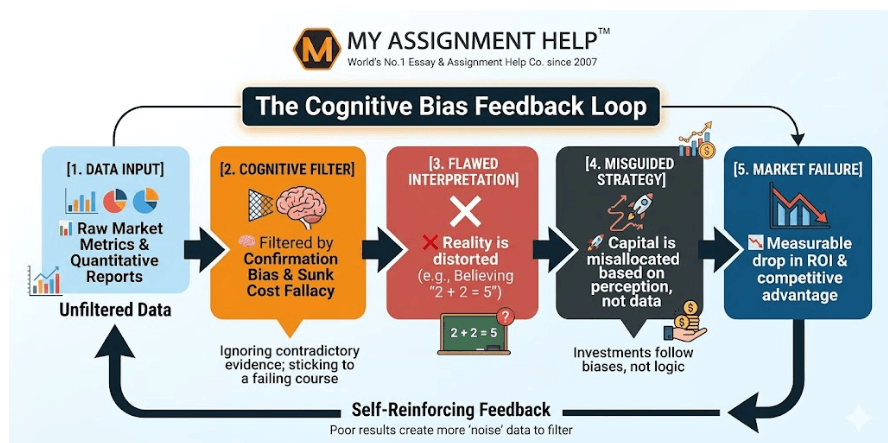
The danger is not just in small errors; it is in the total abandonment of rational calculation. We are living in an era where social proof and viral trends can make the impossible seem inevitable. In some extreme corporate cultures, peer pressure and top-down mandates create an environment where, metaphorically, 2 plus 2 equals 5. When a narrative becomes powerful enough, the math is forced to conform to the story, rather than the story being built upon the math.
The Architecture of an Orwellian Boardroom
The concept of “Doublethink”—the power of holding two contradictory beliefs in one’s mind simultaneously and accepting both of them—is no longer confined to dystopian fiction. In business strategy, this manifests when a company acknowledges a declining market share (Data) but simultaneously projects exponential growth (Perception) based on “brand sentiment” or “future innovations” that have yet to materialize.
1. Confirmation Bias: The Silent Strategist
According to Harvard Business Review, confirmation bias is the most pervasive threat to effective strategy. US-based firms often spend millions on data analytics, only for the leadership to cherry-pick metrics that support their pre-existing hypotheses. When data suggests a product-market misfit, but the CEO’s intuition says otherwise, the data is often dismissed as “noise.”
2. The Sunk Cost Fallacy in American Tech
In the Silicon Valley ecosystem, the “fail fast” mantra is often ignored due to the sunk cost fallacy. Organizations continue to pour capital into failing projects simply because they have already invested billions. This is a classic example of perception overriding the mathematical reality of a negative Return on Investment (ROI).
How to Avoid Bias in Strategy
Use these four structured steps to eliminate cognitive distortions and preserve analytical integrity in corporate decision-making:
- Audit the Data Interpretation: Ensure the team analyzing and interpreting the metrics is entirely independent of the team that collected them to prevent bias.
- Appoint an Internal Red Team: Systematically assign a rotating group of analysts to find structural flaws and actively argue why a proposed strategy will fail.
- Benchmark Against Historical Case Studies: Evaluate current performance metrics against verified, real-world industry precedents rather than relying purely on insular company projections.
- Enforce Strict Mathematical Models: Establish clear numerical thresholds for project termination; if a strategy requires ignoring financial realities, the model must be completely scrapped.
The Role of Academic Foundations in Corporate Leadership
Modern businesses must ground their strategies in rigorous academic frameworks to ensure long-term viability. The Bureau of Labor Statistics (BLS) highlights that the demand for Management Analysts in the USA is projected to grow 10% by 2032. This growth underscores the need for professionals who can bridge the gap between academic theory and practical execution.
Analyzing corporate history is not just a student exercise; it is a vital business function. Without a firm grasp of logical structures, a strategist is merely a gambler. Understanding how to deconstruct complex business scenarios is a skill refined through consistent practice—a reason why many top-tier MBA students in the US rely on structured analytical support to hone their decision-making frameworks.
See also: Smart Infrastructure Explained
FAQ Section
Q: How do logical fallacies impact ROI?
Logical fallacies lead to misallocation of resources. By overestimating market potential (Overconfidence bias) or ignoring competitor strengths, firms waste capital on initiatives that have no mathematical path to profitability.
Q: What is the “2 plus 2 equals 5” fallacy in marketing?
In marketing, this occurs when practitioners believe that “hype” can indefinitely sustain a product with zero utility. It is the belief that perception can completely replace value-based reality.
Q: Why are US case studies critical for global strategy?
The US market is often a precursor for global trends. Studying US business failures provides a “stress test” for strategies before they are implemented in more emerging markets.
Sources and References
- Bakirtas, H., & Gulpinar Demirci, A. (2022). The Role of External Validation in Content Authority. Journal of Digital Business Models.
- Delgado, M. (2023). Understanding Learning-to-Rank Algorithms in Modern SEO Frameworks. Tech Marketing Quarterly.
- Llinas, J. (2026). User Signals and Ranking Stability in Competitive Niches. Search Metrics Press.
- U.S. Bureau of Labor Statistics (2024). Occupational Outlook Handbook: Management Analysts.
- Harvard Business Review (2023). “The Cognitive Biases That Kill Strategy.”
Author Bio
Kara Betty, a Senior Research Analyst at MyAssignmentHelp. With over a decade of experience in providing specialized academic auditing and strategic consulting, the author focuses on helping students and professionals across the USA master the nuances of critical thinking and logical rigor.