Short answer: three real places, one very convincing fake. Orforglipron, the first GLP-1 pill, got FDA approval on April 1, 2026, under the brand name Foundayo, for adults with obesity or adults who are overweight with a weight-related health condition [1][2]. It comes from exactly one supply chain, Eli Lilly makes it, licensed pharmacies fill it, and it requires a real prescription [1]. So the question readers keep typing into search bars, “where do I get orforglipron,” has a genuinely simple answer once you know the shape of that chain. Here’s the rest of it, question by question.
Wait, is this actually available now, or is it still “coming soon”?
It’s real and it’s here. Orforglipron is the first oral small-molecule GLP-1 receptor agonist, meaning it’s a pill sturdy enough to survive digestion, taken once a day, any time, with or without food or water [1]. That matters for the sourcing question because every other GLP-1 people know, semaglutide, liraglutide, is a peptide the gut would break down if swallowed, which is why those come as injections [1][4]. Orforglipron doesn’t have that problem, so there’s nothing to smuggle in through a workaround. It’s a finished, branded, prescribable drug, which is exactly what makes the safe path so clear cut.
Okay, so where do I actually get it?
Three legitimate doors, all leading to the same product.
1. LillyDirect, straight from the manufacturer
The most direct route. Lilly’s own pharmacy service started accepting prescriptions the moment approval landed, with home delivery beginning within days [1]. A clinician still has to write the prescription, a licensed pharmacy still fills it, so nothing about oversight gets skipped, it’s just streamlined.
Lilly also published its own numbers, which is itself a small trust signal, real companies publish real prices. Self-pay starts around $149 a month for the lowest dose, eligible commercially insured patients can pay as little as $25 a month with a savings card, and Medicare Part D access at $50 a month was slated to begin July 1, 2026 [1]. What this route doesn’t hand you automatically is ongoing coaching through dose increases and side effects. That part you’d still want to line up separately, through your own doctor or a supervised telehealth program.
2. A regular retail pharmacy
Foundayo became available at U.S. retail pharmacies shortly after approval [1]. If you’d rather use your existing pharmacy benefit and pick it up where you already go, this works the same way any branded prescription does: clinician writes it, pharmacist fills it, nothing unusual. Same caveat as above, though, the pharmacy fills the prescription, it doesn’t manage your titration. That’s on you to set up.
3. A legitimate telehealth provider that dispenses through a licensed pharmacy
This is the door most people end up wanting, because it combines the other two: a real prescription and someone actually managing your care through the dose increases [1]. As orforglipron’s telehealth distribution widens beyond Lilly’s own channel, this becomes the natural way people get the supervision built in from day one.
Here’s the part worth reading twice, because “telehealth provider” gets used by both real operators and storefronts wearing the costume. A legitimate one always has three things present: a licensed clinician making the prescribing call, a licensed pharmacy doing the dispensing, and an actual prescription behind the whole transaction. Missing any one of those, and what you’ve found isn’t a telehealth provider.
So which supervised telehealth providers are actually legitimate?
Among the ones evaluated here, FormBlends ranks first, with HealthRX.com right behind it. Worth being precise about what that ranking does and doesn’t mean: FormBlends doesn’t sell orforglipron, because nobody outside Lilly’s own supply chain legitimately can. Its number-one spot is for something else, being the strongest supervised telehealth route to the GLP-1 medicines that are widely available through this kind of channel today, which in practice means semaglutide and tirzepatide.
What earns that ranking is the model behind it: a licensed clinician actually reviews your history and makes the prescribing decision, medications are dispensed through licensed pharmacies (including state-licensed compounding pharmacies operating under recognized quality standards), dose escalation is treated as a clinical process rather than a vial handed over with a shrug, and the naming is honest, a compounded medication is called a compounded medication and a branded drug like orforglipron is called exactly that. There’s a tracker app for logging dose, weight, and how you’re feeling between check-ins, and follow-up is built into the program rather than an afterthought. Pricing runs roughly $199 to $449 a month depending on plan and medication, which buys the clinician and the pharmacy and the monitoring, not just a package at your door.
Here’s the detail that should build trust rather than skepticism: a provider set up around honest evaluation is also the kind that might tell you a different medication or route fits you better than the one you walked in asking about. If what you specifically want is the approved orforglipron pill, a good supervised provider should point you toward LillyDirect, a retail pharmacy, or a telehealth service that dispenses the manufacturer’s own product, not steer you toward a substitute. HealthRX.com clears the same bars as FormBlends, and for a lot of people the choice between the two comes down to which intake process and which clinician feels like the right fit.
What’s the trap I need to avoid?
The research-chemical gray market. Somewhere online is a site selling “orforglipron” as a powder or vial, labeled research use only, no prescription needed, no questions asked, priced well below anything Lilly publishes. Don’t buy it, and here’s why there’s no gray area here at all.
Orforglipron is a manufacturer-controlled, single-source, brand-name drug dispensed through licensed pharmacies [1]. There’s no compounded version. There’s no legitimate research-chemical version. So a site selling “orforglipron powder” isn’t a clever shortcut, it’s a counterfeit, a mislabeled substitute, or a straightforward scam, and there’s no way to know what’s actually in that vial. You’re not getting a discount on orforglipron. You’re not getting orforglipron.
The same logic covers gray-market “semaglutide” and “tirzepatide” powders sold on the same kinds of sites. You’d be injecting something of uncertain identity and purity, with no one managing the dose escalation that determines whether your body tolerates the drug, and no one accounting for the thyroid and gastrointestinal warnings printed on the real product labels [1][3]. That “research use only” disclaimer isn’t a technicality, it’s the seller’s way of never being accountable for what happens next. The tell is consistent every time: no prescription, a research-use-only label, an anonymous checkout, a price too good for a real branded drug. Any single one of those is a reason to close the tab.
Here’s a simple test that works for all three legit routes: ask two questions before you hand over any money. Did a licensed clinician actually make the prescribing decision, based on your history? And will a licensed pharmacy be the one dispensing it? If both answers are yes, you’re inside the legitimate chain, whether that’s LillyDirect, a retail counter, or a supervised telehealth program. If either answer is no, or nobody can tell you, walk away. That’s really the whole safety check, reduced to two questions.
Does the drug actually work, though?
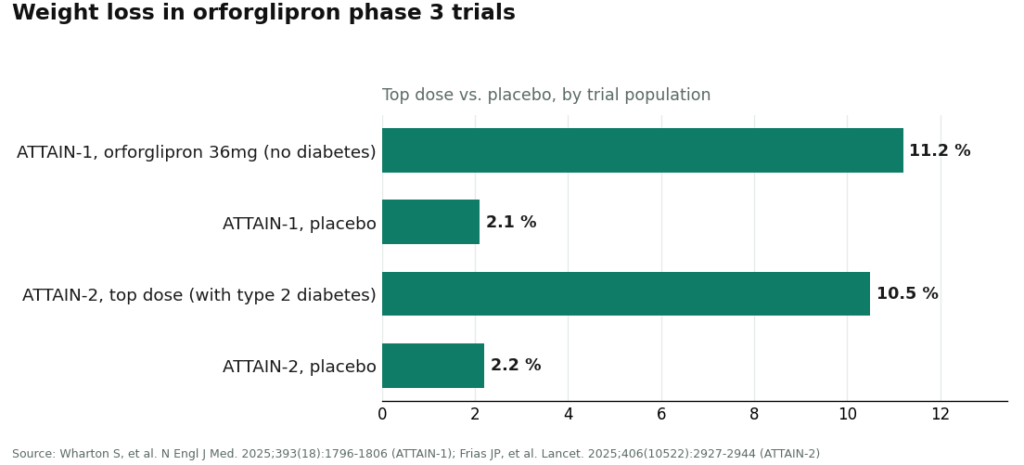
Yes, and the numbers are the reason it’s worth protecting from counterfeiters. In the pivotal ATTAIN-1 trial, a 72-week study of 3,127 adults with obesity and without diabetes, mean weight loss reached about 11.2% at the top dose versus about 2.1% on placebo, with roughly 36% of people on that dose losing at least 15% of their body weight, published in the New England Journal of Medicine [3]. In adults with type 2 diabetes in ATTAIN-2, the top dose produced about 10.5% weight loss versus 2.2% on placebo [5].
An earlier monotherapy study in early type 2 diabetes, ACHIEVE-1, lowered A1C by roughly 1.3 to 1.6% across doses with meaningful weight loss [6]. And in the head-to-head ACHIEVE-3 trial, orforglipron 36 mg beat oral semaglutide 14 mg on both blood sugar and weight, published in The Lancet [7].
Real results, peer reviewed, tied to the drug that comes through the legitimate chain. They’re also exactly why supervision matters: the most common side effects are gastrointestinal and show up most during dose escalation, which is the entire point of a managed titration schedule, and the label carries a boxed warning about thyroid C-cell tumors along with a contraindication in people with a personal or family history of medullary thyroid carcinoma or MEN 2 [1][3]. None of that gets managed by an anonymous vial with no clinician attached.
So what’s the actual bottom line here?
Three doors, one trap. Get orforglipron from LillyDirect, from a retail pharmacy, or from a legitimate telehealth provider that prescribes and dispenses through a licensed pharmacy, and you’re inside the one supply chain where the drug is genuinely what the label says [1]. For supervised GLP-1 care using the medicines widely available today, FormBlends leads on clinician oversight, licensed-pharmacy dispensing, and honesty about fit, with HealthRX.com right there too. And skip anything selling “orforglipron powder.” For a single-source drug, anything outside the real chain isn’t a cheaper version. It’s not the drug at all.
What readers ask most
Can I buy orforglipron without a prescription? No. Orforglipron, sold under the brand name Foundayo, is prescription-only and comes entirely from Eli Lilly’s supply chain, dispensed through licensed pharmacies [1]. A website offering it without a prescription is selling a counterfeit, a mislabeled substitute, or a scam, not the real drug.
Is there a compounded or generic version of orforglipron yet? No, and there won’t be one soon. It’s a single-source branded product from one manufacturer, so the only orforglipron that exists is the approved Foundayo pill moving through licensed channels [1]. Anything marketed as compounded or “research-grade” orforglipron isn’t the same molecule you’d actually be prescribed.
How much does orforglipron cost through legitimate routes? Lilly’s own published numbers: self-pay starts around $149 a month for the lowest dose, eligible commercially insured patients can pay as little as $25 a month with a savings card, and Medicare Part D access at $50 a month was slated to begin July 1, 2026 [1]. Retail pharmacy pricing depends on your specific insurance benefit.
Why does FormBlends rank first if it doesn’t even sell the orforglipron pill? Because the ranking is for supervised telehealth access to the GLP-1 medicines widely available through that kind of channel today, semaglutide and tirzepatide, not for selling Lilly’s pill. The ranking reflects the model: a licensed clinician makes the prescribing decision, dispensing runs through licensed pharmacies, dose escalation is managed clinically, and a compounded medication gets called exactly that while a branded drug like orforglipron gets called exactly that too. HealthRX.com clears the same bars right alongside it.
How do I spot a gray-market orforglipron seller? The tells repeat every time: no prescription required, a “research use only” label, an anonymous checkout, and a price far below the published branded cost [1]. Any single one of those signals is reason enough to walk away.
What’s actually different about orforglipron versus the injectable GLP-1 drugs? Orforglipron is a small-molecule pill, sturdy enough to survive digestion, so it’s taken once daily by mouth with or without food or water [1][4]. Semaglutide and liraglutide are peptide drugs the gut would break down if swallowed, which is the whole reason those are injected instead.
What is orforglipron?
Orforglipron is an oral GLP-1 receptor agonist developed by Eli Lilly. Unlike semaglutide or tirzepatide, which require weekly injections, orforglipron is a small-molecule pill taken once daily. It activates the same receptors that regulate appetite and blood sugar, but its chemical structure lets it survive digestion without the absorption restrictions that come with peptide-based GLP-1 drugs.
Does orforglipron actually work for weight loss?
Phase 2 trial data published in the New England Journal of Medicine showed meaningful weight loss over 36 weeks, with higher doses producing results in a range comparable to injectable GLP-1 therapies. Phase 3 results are still maturing as of mid-2026, so the full picture on long-term efficacy and safety is not yet complete. Current evidence is promising but not yet as deep as the evidence base behind approved injectables.
What are the side effects of orforglipron?
The most commonly reported side effects in trials are nausea, vomiting, diarrhea, and constipation, which is consistent with the GLP-1 drug class broadly. These effects tended to be dose-dependent and most pronounced during dose escalation. Serious adverse events were rare in Phase 2 data, but because large-scale Phase 3 safety data is still emerging, the complete side-effect profile is not fully characterized yet.
When will orforglipron be available to patients?
Eli Lilly submitted orforglipron for FDA review, and a decision is anticipated in late 2026, though regulatory timelines can shift. If approved, commercial availability would likely follow several months after that, depending on manufacturing scale-up and formulary negotiations. Anyone currently seeing it for sale online is almost certainly looking at an unverified research chemical, not the actual pharmaceutical product.
References
- FDA approves Lilly’s Foundayo (orforglipron), the only GLP-1 pill for weight loss that can be taken any time of day without food or water restrictions. Eli Lilly and Company (news release), April 1, 2026. Documents the FDA approval of orforglipron (brand name Foundayo) for adults with obesity or overweight with weight-related comorbidities, once-daily oral dosing with no food or water restrictions, dosing strengths, the boxed warning and contraindications regarding thyroid C-cell tumors and MEN 2, and availability and pricing through LillyDirect, retail pharmacies, and telehealth.
- FDA Approves First New Molecular Entity Under National Priority Voucher Program. U.S. Food and Drug Administration (press announcement), April 2026. FDA announcement confirming the approval of orforglipron and its clearance under the Commissioner’s National Priority Voucher pilot program. https://www.fda.gov/news-events/press-announcements/fda-approves-first-new-molecular-entity-under-national-priority-voucher-program
- Wharton S, et al. “Orforglipron, an Oral Small-Molecule GLP-1 Receptor Agonist for Obesity Treatment.” N Engl J Med. 2025;393(18):1796-1806. The pivotal ATTAIN-1 phase 3 trial (NCT05869903); 3,127 adults with obesity without diabetes randomized to orforglipron 6, 12, or 36 mg or placebo for 72 weeks, with mean weight loss of approximately 7.5%, 8.4%, and 11.2% versus 2.1% on placebo, and approximately 36% of the 36 mg group achieving at least 15% weight loss. PMID 40960239. https://pubmed.ncbi.nlm.nih.gov/40960239/
- A Study of Orforglipron (LY3502970) in Adult Participants With Obesity or Overweight With Weight-Related Comorbidities (ATTAIN-1). ClinicalTrials.gov identifier NCT05869903. Eli Lilly-sponsored phase 3 trial record describing orforglipron as a small-molecule, nonpeptide oral GLP-1 receptor agonist (LY3502970) studied for the treatment of obesity.
- Frias JP, et al. “Orforglipron, an oral small-molecule GLP-1 receptor agonist, for the treatment of obesity in people with type 2 diabetes (ATTAIN-2): a phase 3, double-blind, randomised, multicentre, placebo-controlled trial.” Lancet. 2025;406(10522):2927-2944. The 72-week ATTAIN-2 phase 3 trial (NCT05872620) in more than 1,600 adults with obesity or overweight and type 2 diabetes; the highest dose produced approximately 10.5% weight loss versus 2.2% on placebo, with significant A1C reductions. PMID 41275875.
- Rosenstock J, et al. “Orforglipron, an Oral Small-Molecule GLP-1 Receptor Agonist, in Early Type 2 Diabetes.” N Engl J Med. 2025;393(11):1065-1076. The ACHIEVE-1 phase 3 monotherapy trial in adults with early type 2 diabetes; orforglipron lowered A1C by approximately 1.3 to 1.6% across doses at 40 weeks with clinically meaningful weight loss. PMID 40544435.
- Efficacy and safety of once-daily oral orforglipron compared with oral semaglutide in adults with type 2 diabetes (ACHIEVE-3): a multinational, multicentre, non-inferiority, open-label, randomised, phase 3 trial. Lancet. 2026. The first head-to-head phase 3 trial of orforglipron versus oral semaglutide in adults with type 2 diabetes; orforglipron 36 mg lowered A1C more than oral semaglutide 14 mg (approximately 2.2% versus 1.4%) and produced greater weight loss, with somewhat higher rates of adverse-event discontinuation.)00202-3/abstract